FISH Hybridization System
FISH Hybridization System
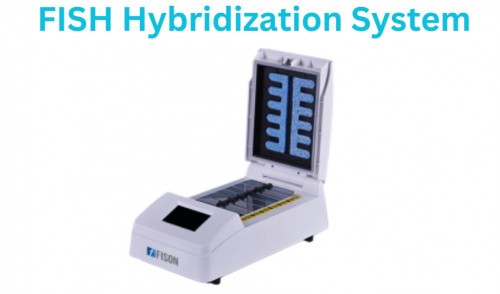
FISH Hybridization System is a compact and benchtop model, adopted with FISH processing step and three operation modes as denaturation plus hybridization, hybridization, and multiple-step operation. It offers 12 slides capacity, 0 to 100°C of temperature range and automatic cooling and warm-up function with 1 min to 99 h 59 min of time range. Features touch screen interface, automatic power recovery, high precise temperature control and 105 custom stored programs, ensures reliable results with high efficiency and accuracy. used for the detection and visualization of specific nucleic acid sequences within cells or tissue samples. Fluorescence in situ hybridization allows researchers to study the spatial distribution and abundance of specific DNA or RNA sequences in chromosomes, cells, or tissues.FISH involves the use of specific probes short sequences of DNA or RNA labeled with fluorescent dyes. These probes are designed to complementarily bind to the target nucleic acid sequences.Probes are labeled with fluorescent dyes that emit detectable signals when exposed to specific wavelengths of light.Labeled probes are applied to the sample, and hybridization occurs when the probes bind specifically to complementary sequences in the denatured DNA or RNA. This step allows for the visualization of the target sequences.
FISH Hybridization System is a compact and benchtop model, adopted with FISH processing step and three operation modes as denaturation plus hybridization, hybridization, and multiple-step operation. It offers 12 slides capacity, 0 to 100°C of temperature range and automatic cooling and warm-up function with 1 min to 99 h 59 min of time range. Features touch screen interface, automatic power recovery, high precise temperature control and 105 custom stored programs, ensures reliable results with high efficiency and accuracy. used for the detection and visualization of specific nucleic acid sequences within cells or tissue samples. Fluorescence in situ hybridization allows researchers to study the spatial distribution and abundance of specific DNA or RNA sequences in chromosomes, cells, or tissues.FISH involves the use of specific probes short sequences of DNA or RNA labeled with fluorescent dyes. These probes are designed to complementarily bind to the target nucleic acid sequences.Probes are labeled with fluorescent dyes that emit detectable signals when exposed to specific wavelengths of light.Labeled probes are applied to the sample, and hybridization occurs when the probes bind specifically to complementary sequences in the denatured DNA or RNA. This step allows for the visualization of the target sequences.
Reactions
Be the first to write a review.
Related products in the region
 Single Beam UV-Visible Spectrophotometer
Single Beam UV-Visible Spectrophotometer A Single Beam UV-Visible Spectrophotometer measures the absorbance or transmittance of light at a single wavelength. It operates by comparing the int...
 Synchronous Thermal Analyzer
 Synchronous Thermal Analyzer The Synchronous Thermal Analyzer represents a cutting-edge instrument that seamlessly combines Thermo Gravimetric Analysis (TGA) and Differential Scanning Ca...
 Stomacher Blender
 Stomacher Blender The Stomacher Blender stands as a sophisticated slap-type homogenizer, The slap-type homogenizer ensures effective and consistent homogenization of samples. This mechanism ...
 Stereo Microscope
Stereo Microscope The Stereo Microscope is equipped with a zoom optical system, providing users with a wide magnification range. This feature is particularly valuable for applications where...


Related businesses
Moon Guitars LtdKintail
Fletcher
Wallace Bag Pipes
Pipe Dreams
Mark J Collins - Luthier
Macleod Highland Supplies
Willis
John Weston Bagpipes
Tru-Tone
Stirling Bagpipes
Tru Tone Ltd
Macmurchie Bagpipe Makers
Inveran Bagpipe Makers
Hamish Moore
Bagpipes Of Caledonia
Kiberry Bagpipes
W M Sinclair & Son